- Publisher: Popular Science
- Editor: Sarah Durn
- Published: June 9, 2026
From my Century In Motion column on Pop Sci
But personal rapid transit never got off the ground. That is, until Silicon Valley stepped in.
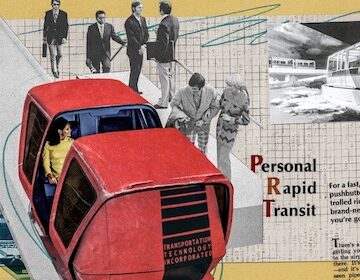
In 1953, Donn Fichter, a graduate student at Northwestern University in Chicago, had a simple transportation idea: What if you tipped an elevator on its side, enabling it to run horizontally, and set it loose in a city? Unlike conventional urban mass transit, elevators are responsive to individuals, callable with the push of a button, and not subject to schedules.
After completing his dissertation in 1958, “Automated Urban Circulation,” Fichter spent years turning that idea into a complete transit system design he called Veyar. At its core, Veyar would offer small automated cars running on lightweight guideways. The electric cars would be available at any hour and travel directly from origin to destination without stops, schedules, or drivers. “Personalized transit,” he called it, in which each car “is a self-operating vehicle which can go unattended.”
For 60 years, personalized transit systems like Veyar gained support from generation after generation of transportation engineers, but none were ever built. That’s because personal rapid transit systems demanded infrastructure cities couldn’t afford and automation technology that didn’t yet exist. What finally solved both problems wasn’t a transit agency or a federal program, but rather the autonomous vehicle industry...
Robotaxis almost happened in 1964—with the help of the U.S. government
Many thanks to Sarah Durn, Popular Science Associate Editor.
Enjoyed this story? You might like "Why don’t we use more driving simulators to teach teenage drivers?" in Popular Science