- Publisher: Popular Science
- Editor: Sarah Durn
- Published: September 17, 2026
From my Century In Motion column on Pop Sci
From the record-breaking X-15 to today’s hypersonic aircraft, the spaceplane dream never really died.
In 1926, when Albert Scott Crossfield was five years old, a priest came to his home to administer the last rites. Suffering from an advanced case of pneumonia that had scarred his lungs and attacked his heart, the young Crossfield was drifting in and out of a coma when his parents summoned Father Skiperelli. They feared their son would not make it through the night.
Despite his delirium, Crossfield distinctly remembered Father “Skip” noting how the pictures of airplanes plastered across his bedroom walls were crowding out a symbol of the Sacred Heart. Crossfield survived but struggled with his health for years, which often confined him to bed rest. A doctor told him he would likely never pass a flight physical exam.
When he was nine years old, Crossfield outfitted a wicker chair in the family’s backyard with a cockpit-like control stick and rudder pedals, practicing for hours at a time. He would follow the instructions of a flight book propped on the chair’s arm, imagining himself soaring across oceans and over mountains, setting world records.
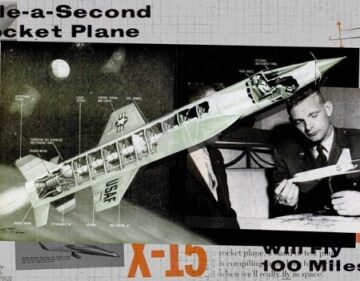
In 1953, Crossfield realized those childhood dreams when he steered a research plane, the Douglas D-558-II Skyrocket, to Mach 2, twice the speed of sound, making him the fastest person alive to date. Six years later, he was the first to pilot the X-15, a new experimental aircraft that was the world’s first plane to fly into space. But reaching space and staying there are different problems...
In 1963, a plane flew to space. Why couldn't we go farther?(opens in new tab)(opens in new tab)
Many thanks to Sarah Durn, Popular Science Associate Editor.
Enjoyed this story? You might like "The uber-optimistic history and prolonged future of space tourism" in Popular Science