- Publisher: Popular Science
- Editor: Sarah Durn
- Published: September 11, 2026
From my Century In Motion column on Pop Sci
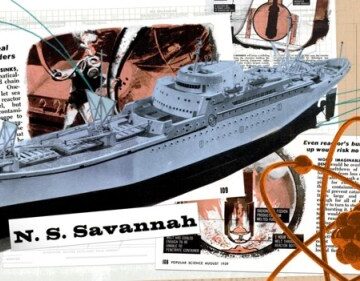
The NS 'Savannah' even offered a view into the reactor powering the state-of-the-art ship.
By the time naval architecture firm George G. Sharp tasked Jack Heaney with the design of the world’s first nuclear-powered merchant ship, the Glasgow-born designer(opens in new tab) had already broken many styling norms. In the mid-1940s, Heaney transformed routine ocean transport into a festive occasion when he designed the interiors of the SS President Wilson and SS President Cleveland(opens in new tab) with Hawaiian murals, carved glass panels, and a smoking lounge dressed in playful, exotic wall art. His gift for making the mundane desirable wasn’t confined to ocean liners—New York’s Museum of Modern Art had already put one of his stackable aluminum chairs on display(opens in new tab) in 1947. But nothing in Heaney’s career had prepared him for the commission that reached his drawing board in 1957.
At the time, the shadow of 1945, when the world first witnessed the terrifying power of the atom, loomed large. Following World War II, the United States and Soviet Union were locked in a nuclear arms race, and the public associated splitting atoms with annihilation. Atoms meant war.
To shift that sentiment, President Eisenhower launched his Atoms for Peace(opens in new tab) initiative, aimed at demonstrating the civilian benefits of nuclear technology—and the NS Savannah, or Nuclear Ship Savannah, was to be its flagship. Heaney suddenly had a much more daunting task than usual; he would have to make the feared desirable...
In 1959, the first nuclear-powered merchant ship set sail before the world was ready(opens in new tab)(opens in new tab)
Many thanks to Sarah Durn, Popular Science Associate Editor.
Enjoyed this story? You might like "What tech learned from Daedalus" in MIT Technology Review